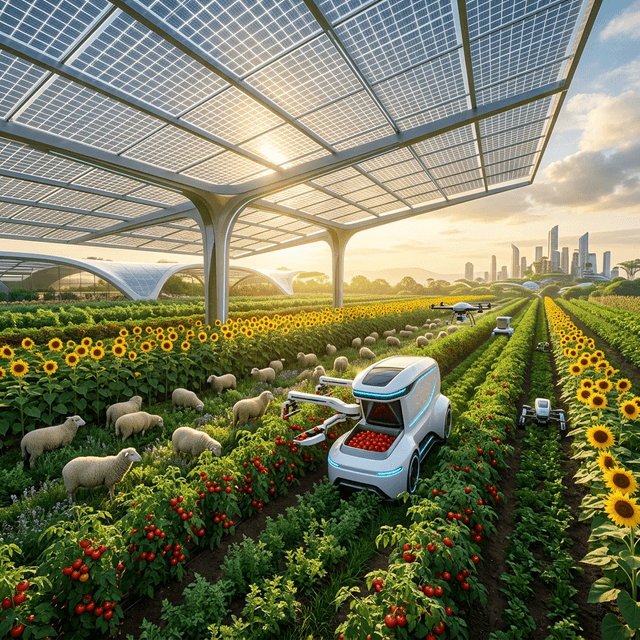
HelioTerraAgrivoltaics optimization engine
HelioTerra finances, designs, and operates agrivoltaic projects that let the same acre produce farm income and solar revenue, with zero upfront cost to the farmer.
Imagine a farm where land does not have to choose between food and energy. Elevated solar arrays create a crop-specific microclimate, the farmer keeps the land in production, and the project earns from both electrons and biology. The big vision is a new asset class for rural America. The first wedge is narrower and sharper: heat-stressed specialty crops in high-irradiance regions, where partial shade and water savings are most likely to create obvious economic upside.
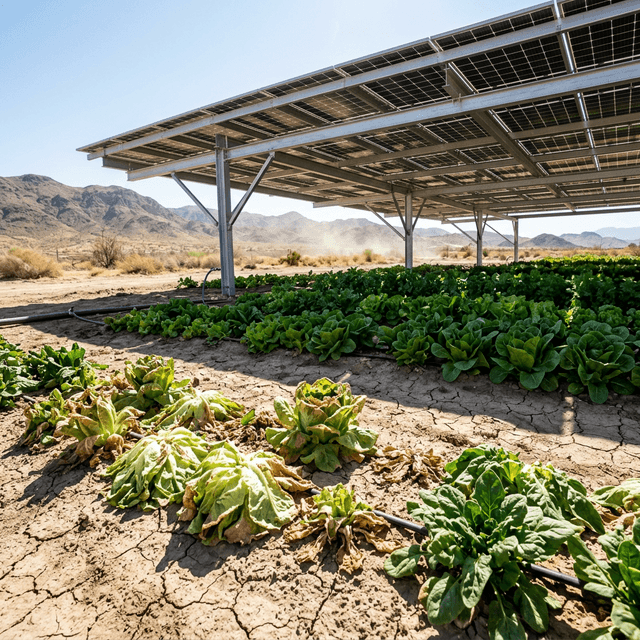
In a 2026 agrivoltaics study, optimized systems increased heat-stressed romaine lettuce yield by up to 483%, while U.S. farm bankruptcies still rose 46% in 2025.
The Problem
HelioTerra is built on a simple thesis: agrivoltaic science is now strong enough to justify scaled deployment, but the financing and delivery stack is still stuck in a single-use world. In the right crops and climates, combining solar and agriculture can increase yield, improve water-use efficiency, preserve grazing productivity, and slightly improve solar output by cooling panels. But traditional solar development is optimized to maximize megawatts, not total value per acre. Traditional farm finance is not built to underwrite a hybrid food-and-energy asset. So a real win-win keeps stalling between categories.
What exists is a false tradeoff between farmland and clean energy. What could exist is a mainstream dual-use asset class where the same parcel produces calories, electrons, rural income, and climate resilience. At civilizational scale, this matters because the U.S. still has 880.1 million acres of farmland, and the Department of Energy says solar capacity may need to reach one terawatt by 2035. If even a modest share of agricultural land can host well-designed dual-use solar, the opportunity is enormous.
Solution Hypothesis
HelioTerra would translate strong but fragmented agrivoltaic science into a bankable deployment model that farmers, developers, and investors can actually use.
The startup would originate suitable parcels, run site-specific agronomic and solar design, structure project finance, coordinate development, and operate the asset after commissioning. Farmers would contribute land access, pay nothing upfront, and receive a base lease plus upside tied to project economics. Developers and capital providers would get a differentiated land-use story, better community acceptance, and a more resilient revenue stack.
The wedge is not "solar on farms." The wedge is bankable dual-use land optimization.
HelioTerra works if it can answer four questions better than anyone else:
- 01.Which parcels are actually strong agrivoltaic candidates
- 02.Which crop system matches the array microclimate
- 03.Which panel geometry maximizes combined food-and-power value per acre
- 04.Which contract structure earns farmer trust and investor confidence at the same time
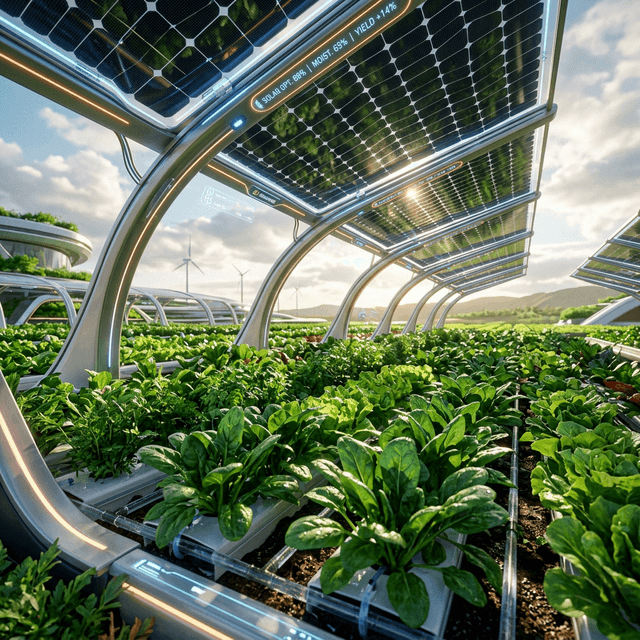
Specific Examples per ICP
EnterprisesGovernmentsHeat-stressed specialty crop grower in Arizona or California
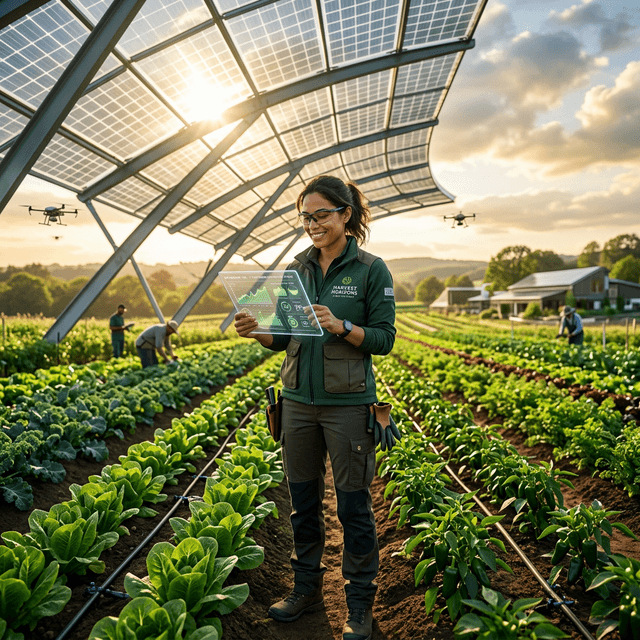
The Science is Ready
2x
Cherry Tomato Output
-10°C
Solar Panel Temps (Up to +3% Yield)
+328%
Water-Use Efficiency
The lesson is not that every acre should get panels. The lesson is that in the right crops, climates, and designs, agrivoltaics is already good enough to commercialize. What remains missing is the operating model.
Neglectedness
Market
This is bigger than the agrivoltaics market-report category. It sits at the intersection of agricultural land, utility-scale solar, rural finance, water stress, and climate adaptation.
From first principles, the opportunity is driven by three massive surfaces: a huge agricultural land base, a very large solar buildout still ahead, and a farm economy under increasing debt pressure. USDA forecasts farm sector debt at $624.7 billion in 2026 and worsening solvency metrics. That makes diversified land income more compelling than it was in an easier farm economy.
The deeper insight is that HelioTerra is not just selling infrastructure. It is selling higher total productivity per acre. That creates multiple monetization layers: development fees, design and underwriting fees, recurring operating fees, revenue share, and eventually software and financing products built on proprietary agrivoltaic performance data.
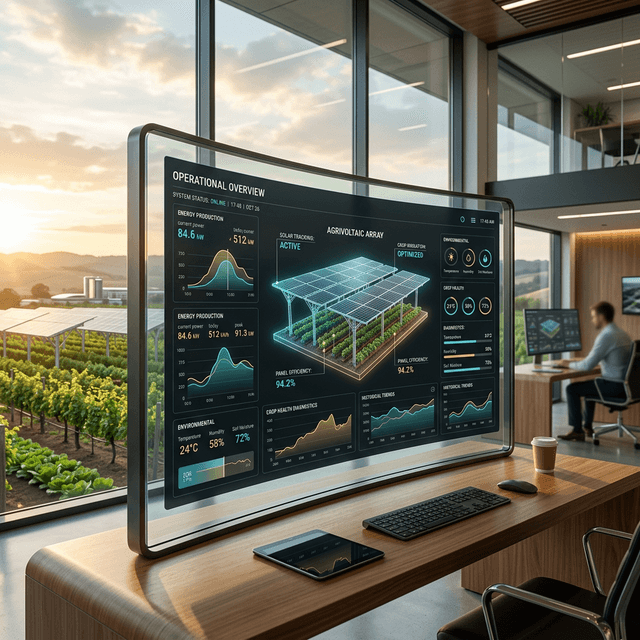
Business Model & Value Flow
PlatformInfrastructureHelioTerra should begin as a capital-light developer-operator and underwriting layer, not as a balance-sheet-heavy asset owner. The elegance is that every stakeholder gets paid from increased total land productivity, not from extracting margin from only one side of the system.
Farmer / landowner
Investor / project capital provider
Developer / utility / community solar sponsor
HelioTerra
Why Now
Build NowThis category has moved from "interesting pilot" to "commercially legible wedge."
The evidence base is now strong enough to target specific high-probability use cases, especially heat-stressed specialty crops and selected grazing systems. Meanwhile, the Department of Energy is openly signaling that the path to one terawatt of solar will require more diverse siting configurations, and the farm economy is under enough pressure that new land-income models are suddenly much easier to pitch. The timing works because the science is no longer hand-wavy, the infrastructure buildout is real, and the economic pain is current.
Moat & Difficulty
Difficulty to Bring to Market
Moat Potential
Go To Market
Unique Go To Market
Build a free HelioScore parcel-ranking tool focused specifically on heat-stressed specialty-crop counties.
A farmer or developer enters an address and gets a dual-use score based on irradiance, water stress, slope, crop suitability, substation proximity, and projected income uplift per acre. That creates instant lead generation, a shareable artifact, and a reason to start landowner conversations before a full development process begins.
Then publish open pilot dashboards showing projected versus actual crop output, solar generation, water-use impact, and farmer income uplift. In a noisy world, visible proof beats pitch decks.
User wedge
Start with heat-stressed specialty crop growers in Arizona, California, and similarly high-irradiance regions. They have immediate biological pain, clearer water economics, and a much easier story to tell around why partial shade could be worth money.
AGI Future Edge
As intelligence becomes abundant, parcel analysis, design iteration, and workflow automation get cheaper. That does not reduce HelioTerra's value. It increases the importance of the things intelligence alone cannot create: land access, trust, financing structures, regulatory navigation, and a real-world operating dataset grounded in biology and project economics.
AGI would help HelioTerra screen parcels, simulate array-crop combinations, automate diligence, draft contracts, and optimize operations. The scarce asset remains the ability to turn abundant intelligence into bankable physical projects on real land.
Civilizational Impact.
HelioTerra is a clean example of abundance thinking. It takes a zero-sum political fight and turns it into a compounding system. The same acre can produce food, electricity, cash flow, and resilience.
That matters because an AGI future will demand more energy, faster infrastructure deployment, and stronger public legitimacy for building. A company that helps society build more solar without forcing a simplistic sacrifice of productive farmland improves climate outcomes, strengthens rural economics, and makes the politics of abundance easier to win.
80Impact Score
Key Performance Indicators
- ✓ Acres under signed feasibility review or letter of intent
- ✓ Conversion rate from HelioScore lead to full diligence
- ✓ Projected versus actual total gross margin per acre
- ✓ Farmer income uplift per acre
- ✓ Time from parcel origination to notice to proceed
First Experiment
Run a 60-day pilot in one target geography...
First Experiment
Run a 60-day pilot in one target geography...
Run a 60-day pilot in one target geography offering free agrivoltaic feasibility assessments to 30 farms.
Quick falsifiable hypothesis: At least 5 landowners request full diligence and at least 1 signs a pilot letter of intent. If that does not happen, the wedge is being targeted wrong, messaged wrong, or priced wrong.
Open Source Priority
Transferable Insight
"When two essential systems compete for the same scarce asset, the startup opportunity is often not in optimizing either system alone. It is in building the financing and operating layer that lets both coexist profitably."
Acronyms & References
Defined terms
- Agrivoltaics: using the same land for agriculture and solar electricity generation
- PV, photovoltaic: solar technology that converts sunlight into electricity
- EPC: engineering, procurement, and construction contractor that builds the project
- LOI: letter of intent, a non-binding agreement that signals serious project interest
References
Builder Proof-of-Work
Community submitted artifacts, notes, and implementations for this idea.