
Own Your Replacement
A worker-first marketplace that prices human workflow data in real time and pays contributors in revenue-sharing tokens, so the people training AI agents and robots can keep a proportional claim on the automation economy they help create.
Each contribution is priced when submitted. Contributors receive tokens immediately. They can sell into liquidity or hold an income-replacement hedge that keeps paying as more buyers purchase access to train on the data over time.
About 52 percent of U.S. workers say they are worried about the future impact of AI in the workplace, and a Reuters/Ipsos poll found 71 percent of Americans fear AI could permanently displace large numbers of workers.
Meanwhile, the AI training dataset market is already measured in the low single-digit billions of dollars and forecast to grow at more than 20 percent annually.
The Problem
AI systems increasingly need real traces of how humans solve problems in software and in the physical world. The current market mostly treats that training data as a one-time procurement problem. Workers get a gig, a fee, or nothing. The platforms and model builders keep the long tail of upside.
That is the tension. Human know-how is becoming machine-legible, but the people generating that value usually do not get a durable stake in what follows.
At civilizational scale, that is a bad design. If automation compounds while ownership stays narrow, trust erodes, backlash rises, and the transition to abundance gets uglier than it needs to be.
Solution Hypothesis
The mechanism is a pricing engine for machine-teachable labor.
Contributors submit task-bounded workflow traces, screen recordings, hand-camera video, audio narration, and metadata. The platform prices each submission at the moment it enters the system using present buyer demand, expected future demand, observed rarity, quality, clarity, and rights cleanliness.
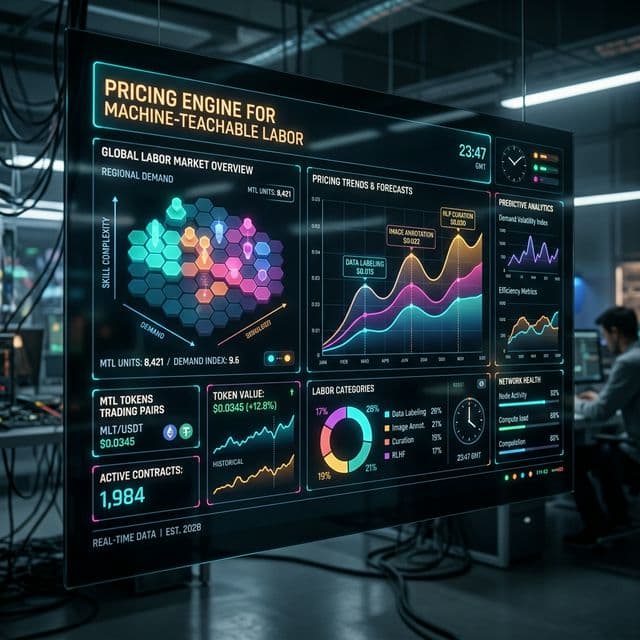
Contributors are paid in platform tokens at submission time. Those tokens represent a proportional claim on platform revenue. Workers can sell immediately for liquidity or hold through time as a hedge against future automation. The product is not just a better data gig. It is a way to convert current labor into long-duration exposure to the upside of the systems that may eventually replace that labor.
The Product Stack
Contributor App
A mobile interface with an earn toggle, payout breakdown, quality feedback, and tailored coaching. Built for tradespeople and domain experts capturing hand-camera or screen workflow traces.
Enterprise Console
Designed for employers to set permissions, define privacy settings on recorded workflows, and negotiate employee-employer value splits. Turns automation threats into shared revenue streams.
Buyer Marketplace & API
A software interface for connecting AI labs, robotics firms, and automation teams requesting and purchasing high-signal workflow datasets. Prices dynamically based on immediate demand.
Rights Layer
Offers multiple access tiers: secure time-bounded training access, premium downloadable dataset licenses for approved use cases, and enterprise-private modes where sensitive data never leaves the boundary.
Specific examples by ICP
A mechanical engineer records a rare constraint-heavy workflow in SolidWorks or Fusion 360, adds a brief voice explanation of the hardest design decision, and receives a premium payout because the task is rare, long-horizon, and clearly narrated. This wedge is credible because VideoCAD shows that high-fidelity CAD interaction traces can train agents on complex design software, using a dataset of more than 41,000 annotated videos.
Data Source Visualization
Verified Workflow Object
Plumber Pipe Repair
Metadata Streams

Pricing algorithm
Open the rules, close the live edge. Open-source the contributor scoring rubric, payout equation, simulator, and audit tools. Keep live demand forecasts, anti-fraud systems, buyer-specific pricing inputs, and adaptive market-making parameters private.
That gives contributors legible rules, faster community improvement, and stronger trust, while reducing the chance that the system gets farmed by bad actors. Trustworthy AI guidance consistently ties transparency and explainability to trust, and transparency does not require open-sourcing every line of production code.
Tagline
Teach the machine. Own the upside.
Neglectedness
The Market
The entry market is AI training datasets and workflow data infrastructure, already a multibillion-dollar category growing quickly.
The larger market is much bigger.Every job that becomes partially automatable creates a new upstream market for machine-teachable labor. Every software copilot, every field-service agent, and every humanoid learning from human traces needs the same thing: rights-cleared, well-labeled, high-signal examples of capable people doing useful work.
"From first principles, the addressable market grows with the surface area of labor that becomes teachable to machines. That is not a niche data-vendor opportunity. It is a new financial and coordination layer for the automation economy."
Why Now
Build NowA labor backlash, a workflow-data bottleneck, and a new generation of trainable agents are arriving at the same time.
Workers are more anxious about AI's effect on jobs. Buyers increasingly need specialized interaction traces, not just scraped internet text. Research systems like VideoCAD show that long-horizon software workflows are becoming a real training substrate for capable agents. That combination opens a narrow and important window to build the ownership layer before the extraction layer hardens.

Business Model & Value Flow
The platform acts as a trust and pricing layer between human workers generating difficult-to-fake workflow traces and the AI labs that need them.
Supply
Workers & Enterprises
- Submit human workflow data
- Can hold tokens as automation hedge
- Can sell tokens immediately for cash
Own Your Replacement
Pricing Engine
Demand
AI Labs & Automators
- Buy category workflow subscriptions
- Fund custom collection campaigns
- Pay premiums for exclusive training rights
Outside Capital
Provides liquidity and price discovery
Evaluation Metrics
Difficulty to Get to Market
Hard, but buildable now with a narrow wedge and disciplined market design.
Moat Potential
This moat compounds in four layers: a live pricing engine, a repository of rights-cleared workflows, contributor trust, and liquidity network effects.
Go To Market
“I'm training my AI replacement, but this time I'm keeping the equity.”
The viral growth loop is simple and native to the chaos of the moment. Short-form posts show the task, the payout breakdown, the coaching tip that increased the next payout, the choice to hold or sell, and the growing value of the worker's automation hedge over time.
That message spreads because it turns a fear into a measurable action.
User wedge:
Start with high-skill software workflows and independent skilled trades. These contributors are easiest to recruit, easiest to instrument, and most likely to produce high-value traces early. Buyers cannot wait because specialized workflow data is already a bottleneck for better agents.

AGI Future Edge
As models get better, the company gets stronger. Better models improve:
- → task segmentation
- → fraud detection
- → contributor coaching
- → future-demand forecasting
- → cross-domain transfer learning across workflows
That creates a compounding feedback loop. As AGI automates more workflows on the path toward superintelligence (ASI), the types of human training data that remain scarce and in demand will constantly evolve. A single platform that captures and prices this remaining edge of human capability uses its token to align incentives perfectly: participants get paid to continually adapt their workflows to exactly what the frontier models need next.
First experiment
Quick falsifiable hypothesis: If skilled contributors can see a transparent payout equation and coaching loop, they will change behavior to create more useful data, and buyers will pay again for the improved second batch.
Smallest test: Pick one wedge, CAD. Recruit 15 skilled contributors. Publish the scoring rubric and payout simulator. Collect 150 hours of narrated workflows. Pre-sell the dataset to one design-agent team. Measure whether contributor behavior improves against the rubric and whether the buyer renews.
Civilizational Impact.
A New Social Contract
This idea does not try to stop automation. It tries to distribute its upside more intelligently.
A New Social Contract
This idea does not try to stop automation. It tries to distribute its upside more intelligently.
If workers can turn their know-how into both present income and a durable share of future automation revenue, automation stops looking like a pure extraction machine. That improves social trust, reduces pressure for blunt anti-technology responses, and creates a more legitimate path from labor displacement to abundance.
HighOpen Source Priority
This idea matters if built, and the space is still underbuilt enough that open-sourcing the idea, the market design, and the contributor-facing pricing framework could meaningfully increase the odds that it is built in a worker-legible, trust-preserving way.
Open source priority is highest for startup ideas that would be civilizationally impactful if implemented; and the space is currently under invested in from a founder quality, capital, or research perspective.
70Impact Score

Key Performance Indicators
- 1. Median contributor earnings per validated hour of workflow data
- 2. Repeat buyer rate within 60 days
- 3. Percentage of submissions purchased at least once
- 4. Gap between predicted value at submission and realized buyer demand
- 5. Percentage of contributors still holding tokens after first liquidity opportunity
Transferable Insight
"When contributors keep meaningful upside, they produce better, more legible, more useful data. Align incentives at the source and data quality improves with it."
Acronyms & References
Acronyms
- CAD: computer-aided design: software used by engineers and designers to create precise 2D and 3D models.
- API: application programming interface: a software interface that lets one system connect to another programmatically.
- Mechanism design: designing the rules of a market so participants are incentivized to produce the outcomes the system wants.
- Revenue-sharing token: a blockchain-based asset that represents a claim on a defined share of platform revenue, subject to legal structure.
References
Valuation Forecast
Probability that the category leader in this space reaches at least each valuation threshold.
AI Rationale
As manual and digital tasks are automated, the need for high-quality, verified human workflow data will surge. Market adoption depends heavily on establishing trust and overcoming regulatory hurdles around tokenized worker compensation. The upside is linked to becoming the standard marketplace for machine-teachable labor.
Implied Valuation Distribution (2030)
While the chart below displays cumulative probability, these boxes break down the exact probability of landing specifically within each valuation band.
Builder Proof-of-Work
Community submitted artifacts, notes, and implementations for this idea.