Open doors.
Open minds.
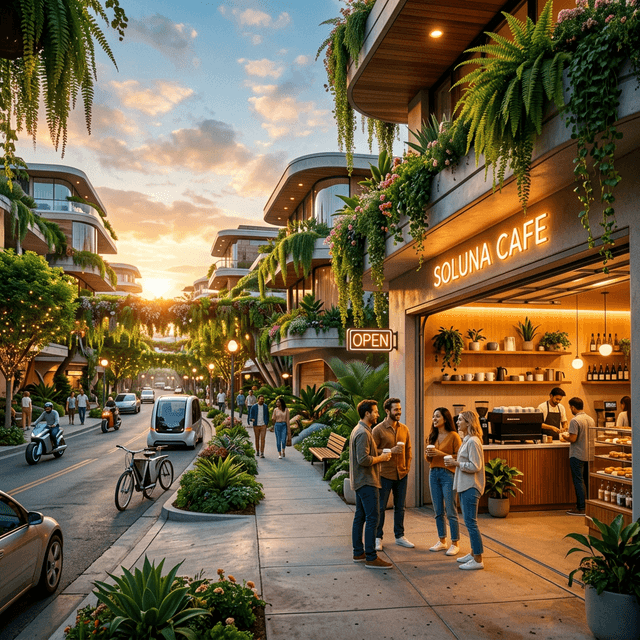
Turn sidewalk-facing garages into community hubs and micro-businesses—with a live neighborhood map, shoppable builds, one-tap installers, and simple tools that reward real-world connection.
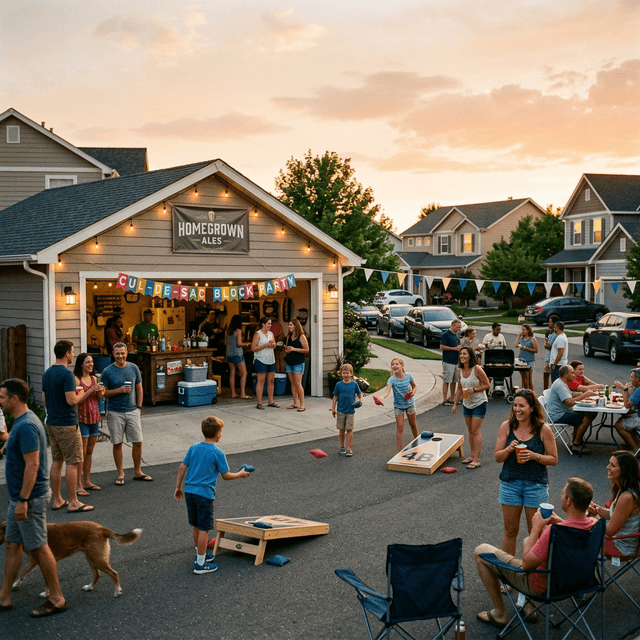
The antidote to isolation is outside your front door.
Roughly half of U.S. adults report loneliness, while driverless ride-hail now delivers ~250k rides weekly across major U.S. metros—early proof that car-light living is coming and garages can shift from storage to social.
The Connection Deficit
U.S. Adults reporting loneliness (%)
Why this movement matters (now)
Americans are lonelier and less civically engaged than we want to be. Re-activating our block-level “third places” measurably improves health and trust. The cultural kindling is there—we supply the spark and the system.
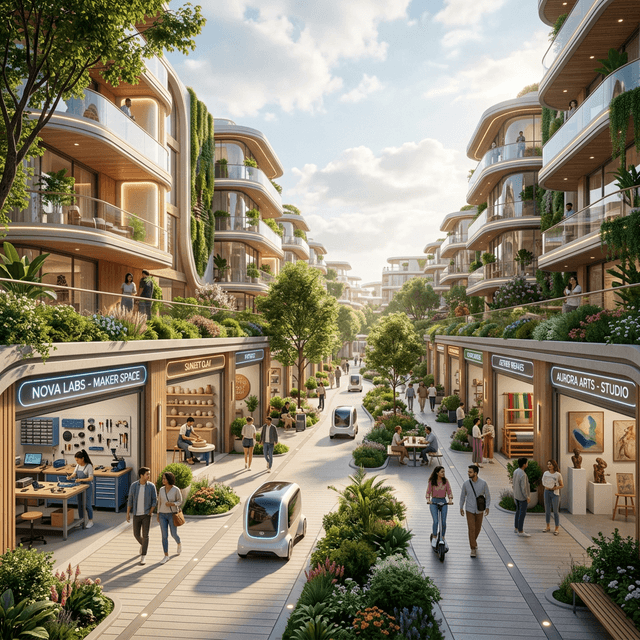
Connection is health.
Small, repeated, face-to-face interactions measurably help combat the social disconnection epidemic.
Walkable Europe shows the appetite.
Pedestrianized, mixed-use streets consistently lift foot traffic and nearby spend—evidence that people crave neighborhood-scale connection.
Policy tailwinds.
ADU and parking-minimum reforms make it easier to adapt small residential spaces; cities are already updating handbooks and guidance.
Autonomy is arriving.
Fewer household cars over time means more sidewalk-facing space dedicated to people, not storage.
Product stack
Community first; compliance as guardrails.
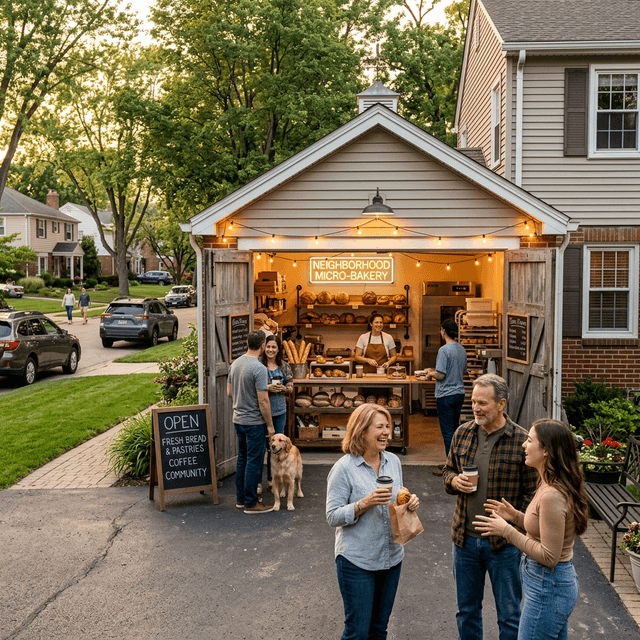
Neighbors (social + discovery)
- Live map + notifications: follow your block; opt into pings when a neighbor “opens”.
- Channels: “who’s open tonight,” family-friendly tags, music/arts, maker hours.
- Reputation that matters: “Great Host,” “Kid-Friendly,” “Quiet-Hours Champ.”
- Block dashboard: visits, new connections, return-visitor rate—privacy-respecting metrics.
Market (inspiration → cart → install)
- Shoppable inspiration: hosts tag their build; viewers can buy the same gear; creators auto-earn referral revenue.
- Compliance badges: egress/ADA/noise options reduce friction without killing the vibe.
Kits (our hero SKUs)
- Social Core: fold-out seating + warm lighting + quick-close privacy screen.
- Micro-Biz Shells: lockable service wall, QR window, compact storage.
- Quiet-hour assist: soft caps on light/sound the host can set.
Studio (garage business software)
- Neighbor-only POS: discounts, tip-jar, shared revenue splits.
- Soft-touch compliance: city-tuned checklists for fire egress/home-occupation rules.
- Analytics: repeat neighbors, dwell time, neighborhood NPS, local spend.
Micro-venture idea bank
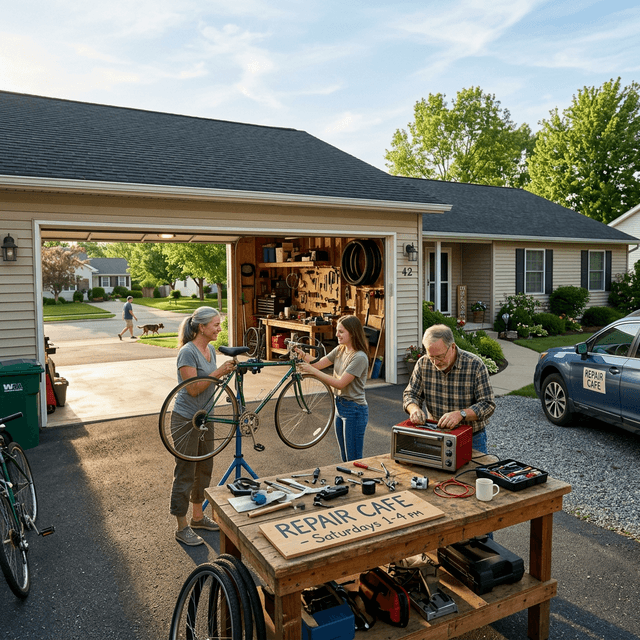
What people already do (home bars, gyms, maker spaces)—supercharged. Start with our starter list.
Real-world Connection Badges
Sell physical plaques (mailbox-sized metal or sustainable wood) that update via QR/NFC—like YouTube subscriber plaques, but for neighbors met and events hosted.
- “Porchfront 100 / 500 / 1,000 Connections”
- “Incident-Free 1000 PorchHours”
- “Porchfront District Founder”
Badges sync with Neighbors stats; hosts can proudly hang them outside or inside. Great UGC.
Neglectedness
Brand-powered block parties
Neighborhood captains can request sponsored Open-Garage Nights.
- Brand toolkits: signage, sample drops, lawn games, “conversation starters.”
- Guaranteed word-of-mouth: host referral links, local leaderboard, photo ops.
- Measurement brands love: footfall, dwell time, local mentions—plus conversion on shoppable kits after the event.
Business model
Kits margin
35–50% blended; optional $5–$9/mo for the PorchHours controller.
Marketplace take
12–18% on third-party SKUs; creator/host referral share.
Services
10–15% booking on Pros.
Studio SaaS
Free community tier; $19–$79/mo for micro-biz tools.
Sponsors/City
Funded block-party circuits + “Porchfront District” activations.
Risks & Moats
Zoning & Compliance Friction
Local zoning laws remain the largest barrier to converting residential garages into commercial spaces.
Hardware Margins & Fulfillment
Shipping large physical kits into residential areas is logistically challenging and traditionally low-margin.
The Neighborhood POS Integration
Owning the point-of-sale specifically tailored for hyper-local micro-commerce creates extreme lock-in.
Hyper-Localized Network Effects
Once a neighborhood hits critical mass, the cost for a competitor to rip-and-replace the social graph is astronomically high.
AGI Futures
Why this movement compounds exponentially.
Autonomous ride-hail
Reduces the need for private car storage over time; more garages can face the sidewalk as human-scale spaces.
Humanoid robots
Drives setup/ops costs down for ultra-small businesses (load-in/out, cleaning, stocking, simple prep), enabling one-person + robot micro-shops.
Curb appeal, upgraded
Robots can also create and maintain spectacular gardens (planting, pruning, seasonal refresh), making porches more inviting and blocks measurably friendlier.
New technologies change culture, and culture creates newly underutilized space. The opportunity is to identify that space early and build the products, norms, and coordination layer that convert it into the next valuable social and economic frontier.
References
Surgeon General Advisory, Our Epidemic of Loneliness and Isolation.
View Source ↗ScienceDirect, Pedestrianization and the economy..
View Source ↗California ADU Handbook, ADU regulatory guidelines..
View Source ↗Valuation Forecast
Probability that the category leader in this space reaches at least each valuation threshold.
AI Rationale
Next-generation real estate and neighborhood social cohesion networks struggle with monetization. The AGI Futures forecaster model reflects a high likelihood of reaching a $100M+ valuation based on user engagement, but drops off sharply past $1B due to the historical difficulty of extracting high LTV from local community networks.
Implied Valuation Distribution (2030)
While the chart below displays cumulative probability, these boxes break down the exact probability of landing specifically within each valuation band.
Builder Proof-of-Work
Community submitted artifacts, notes, and implementations for this idea.