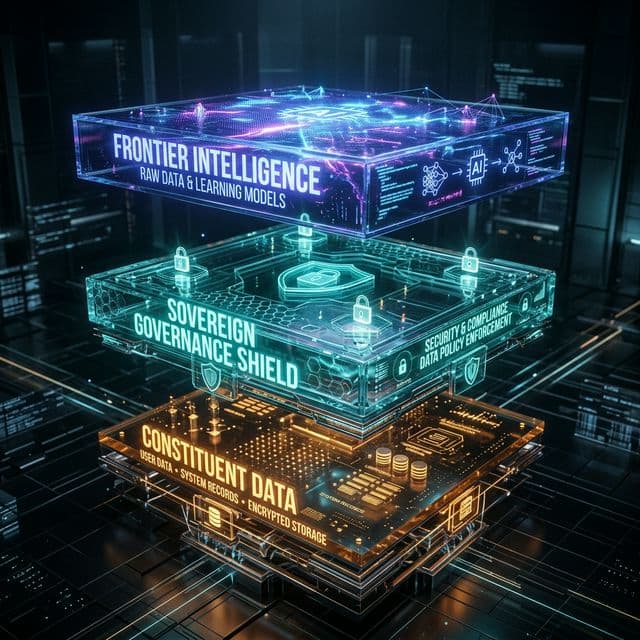

Imagine a city where every permit explanation, procurement recommendation, benefits workflow, zoning summary, and constituent answer is powered by frontier AI, but never feels like outsourced cognition from a foreign black box.
The Intelligence
Global & Frontier
The Governance
Local & Sovereign
The Data
Strictly Protected
The system knows the jurisdiction's laws, procedures, language norms, records rules, and chosen level of citizen input. Some governments will stop at lawful, auditable AI operations. Others will add participatory budgeting, delegated civic input, and policy simulation. Same platform. Different policy appetite.
The Deployment Gap
While nearly all public agencies want to leverage frontier models, an estimated 88% of deployments stall because they lack the sovereign data infrastructure required to connect internal systems safely and legally.
The Problem
The Control Split
Governments want frontier intelligence, but refuse to hand over public reasoning and civic legitimacy to opaque vendors. "Sovereign AI" currently means expensive compute nationalism or weak local replicas.
The Integration Bottleneck
Agencies sit on fragmented legacy databases, GIS data, and restricted case files. They need retrieval boundaries, role-aware redaction pipelines, and audit logs—not just chatbots.
The Civilizational Tension
If states run on unaccountable AI, trust erodes right when intelligence becomes governance. If they run on secure, citizen-calibrated AI, governments get exponentially faster without becoming less legitimate.
Solution Hypothesis
The winning architecture is not "train a national model from scratch." It is a sovereign orchestration and governance layer that sits between frontier models and public workflows.
That layer ingests statutes, regulations, agency rules, case history, language norms, policy memos, procedural steps, appeals history, and optional citizen preference data. It also connects safely to government systems through a privacy-preserving integration fabric: role-based retrieval, field-level permissions, audit logging, encryption at rest and in transit, selective redaction, secure connectors, and deployment options that match the jurisdiction's requirements.
The Modular Civic Stack
Three compounding products build upon the secure orchestration layer to deliver state-level capability.

The product form is a modular civic AI stack. Start with agency copilots and workflow agents. Expand into secure internal knowledge access and action orchestration. Then unlock consultation, machine-readable citizen preference, and policy simulation.
"Frontier intelligence, public control."
Specific Example per ICP

City Government
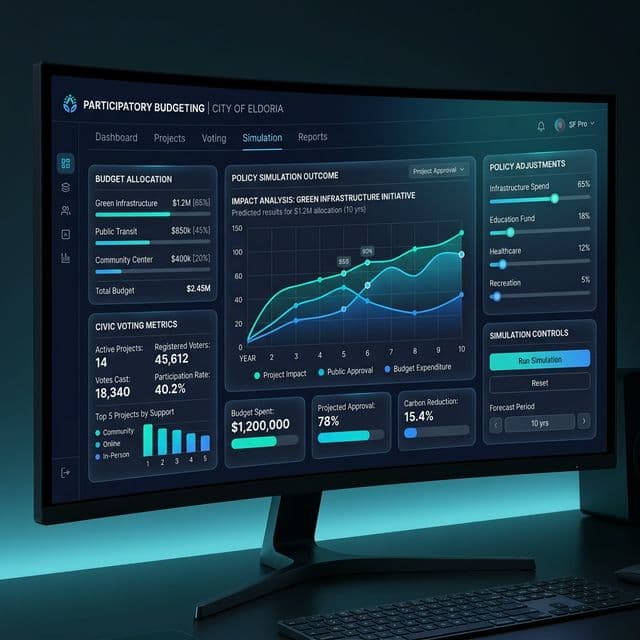
A city deploys Public AI for permitting, zoning Q&A, multilingual constituent support, and participatory budgeting.
Neglectedness
Market
This is bigger than "government software." It is the control layer for intelligence inside public institutions. Every major administrative surface is becoming model-mediated: search, guidance, triage, drafting, routing, explanation, compliance review, procurement support, and eventually bounded autonomous action. Governments are among the largest, stickiest, and most trust-sensitive buyers on earth. Once AI becomes the interface to law, benefits, procurement, urban planning, public-health messaging, and public communication, the most strategic product is not the model alone. It is the control plane that determines how the model behaves inside a jurisdiction.
The Trillion-Dollar Civic Stack
The market starts as public-sector software and expands into civic participation infrastructure, secure data orchestration, policy analytics, human implementation services, and constitutional middleware for AI-native states. The long-term direction is clear: governments will not just buy AI. They will buy governed intelligence systems that fit their institutions.
Why Now
The Trust Inflection
Three curves are crossing. Frontier models are finally strong enough to handle real government workflows. Sovereign AI has become an active national and regional priority, not a fringe thesis. And most critically, the trust stack is maturing: retrieval architectures, secure deployment patterns, redaction layers, and identity-aware access controls now make it practical to connect sensitive systems without pretending privacy is an afterthought.
The Labor Substitution Wedge
In the private sector, repetitive knowledge workflows will compress instantly. In government, comparable roles will persist longer because accountability, compliance, and institutional trust demand slower substitution. That means governments will aggressively buy augmentation and co-pilot systems before they buy wholesale replacement—creating a massive services and change-management wedge.
Business Model
- 1Annual Platform License
Jurisdiction-level or agency-level license for Runtime, security controls, governance tooling, model routing, and audit infrastructure.
- 2Usage-Based Revenue
Charges for inference routing, agent actions, secure retrieval calls, simulation runs, and citizen-participation modules.
- 3Implementation Services
High-value AI + human consultation on deployment strategy, system integration, workflow redesign, security posture, and phased rollout.
- 4Managed Governance Layer
Premium recurring service for dynamic policy updates, prompt and policy tuning, evaluation, human QA, red-team testing, records alignment.
- 5Premium Modules
Participatory budgeting, delegated civic preference, multilingual governance packs, procurement copilots, policy simulation, and sector-specific workflow packs.
Moat
The moat is not 'we fine-tuned a model for government.' That gets commoditized. The moat is the live jurisdiction graph plus the implementation layer.
Difficulty to Market
Hard, but more buildable than it first appears if you sequence the wedge correctly.
Unique Go To Market
A staggered wedge into highly-visible digital sovereignty.
Target the Ambitious Few
Sell first to governments that want to be seen as digitally sovereign, not just digitally efficient. The first buyer is not the median bureaucracy. It is the ambitious one with visible workflow pain and leadership cover to experiment.
The 'Ask Your Agency' Wedge
Lead with a concrete wedge: a resident-facing system that answers policy questions with source traceability and secure internal retrieval. Pair that with a white-glove implementation team. In government, software plus trusted humans gets deployed.
Publish Readiness Scorecards
Publish 'Sovereign AI Readiness Scorecards' ranking agencies and cities on sovereign control, traceability, privacy-preserving access, and implementation maturity. The fastest way to get attention is to explicitly show who is governing their intelligence well.
As intelligence gets abundant,
value shifts upward into trust and legitimacy.
Public AI becomes exponentially more valuable as models improve because it can swap in better core models without losing the jurisdictional layer, security posture, or human implementation system. Over time, it becomes the operating system for AI-native governance.
Civilizational Impact
Select to expand analysis89Score
Civilizational Impact
Select to expand analysisThis is a differential defense play for the AI era. The danger is not only misaligned superintelligence at the frontier. It is also millions of smaller misalignments inside states, agencies, and civic systems that become more automated but less accountable. Public AI helps bend that curve the other way. It gives governments a path to adopt powerful AI without defaulting to opaque centralization or reckless data exposure. It gives citizens a path to interact with machine-mediated governance that is legible, auditable, and optionally shaped by their input. If it works, this category becomes part of the institutional immune system for the age of abundant intelligence.
KPIs
- Time-to-answer reduction for government service requests
- Percentage of outputs with successful policy trace and permission-safe retrieval pass
- Security incident rate and unauthorized-access rate
- Appeal or correction rate versus human baseline
- Net revenue retention across agencies and managed-service expansion revenue
First Experiment
Pick one city or ministry workflow with painful policy lookup, fragmented internal data, and multilingual demand. Build a narrow prototype for one domain (e.g. permitting) using an existing frontier model paired with a secure retrieval layer, role-based access controls, and strict policy tracing.
Quick Falsifiable Hypothesis
Staff and residents will prefer a transparent, policy-cited local AI over a generic frontier chatbot by at least 2:1 on trust and usefulness, while the agency cuts response time by at least 50% without generating any unauthorized data exposure events.
Transferable Insight
"In an AGI world, the most valuable companies may not be the ones with the biggest model. They may be the ones that make powerful models safe, legible, and institutionally governable inside high-trust systems."