
SellCraft
Train and get hired by selling real products to virtual customers.
Company-specific simulations that help candidates prove themselves and teams ramp faster in an AI-native world.
The Edge in a Commoditized World
In a world where artificial intelligence makes building products cheaper and feature parity faster, human sales becomes more valuable, not less. Trust, diagnosis, consensus-building, calibrated persuasion, those become the edge. SellCraft turns those skills into something people can actually practice, measure, enjoy, and take with them.
Performance improvement for bottom-ranked agents when coaching feedback was constrained safely.
Faster training for soft-skills learners in immersive virtual reality compared to classroom settings.
Increase in learner confidence to apply soft-skills after VR training, heavily outperforming e-learning.
Sources:
Problem
Sales is still taught and hired like craft knowledge in a pre-AI world. Candidates get filtered by pedigree, resumes, and shallow interviews. Teams ramp through manager time, shadowing, and scattered call reviews. Most companies say they want consultative sellers, but their hiring process barely measures diagnosis, pushback, listening, objection handling, or executive presence.
That gap gets wider as AI spreads. McKinsey reports marketing and sales as one of the functions with the biggest increase in generative artificial intelligence adoption, while the World Economic Forum says employers expect 39% of key skills to change by 2030. If product creation gets cheaper and scripts get commoditized, the premium shifts toward the human layer, judgment under uncertainty, trust under pressure, and the ability to move a messy group to action.
Solution Hypothesis
Build the connected system, not a single tool.
- Pitch Quest makes sales skill acquisition fun, social, and habit-forming.
- Proving Ground turns those same skills into a standardized work sample for hiring.
- Practice turns real company blockers into repeatable drills that shorten ramp and improve field performance.
The mechanism is simple. Simulation creates deliberate practice. Structured scoring creates signal. Real employer demand creates motivation. Shared data across learning, hiring, and ramp creates a compounding skill graph.
Ideal Customer Profile & Value Flow
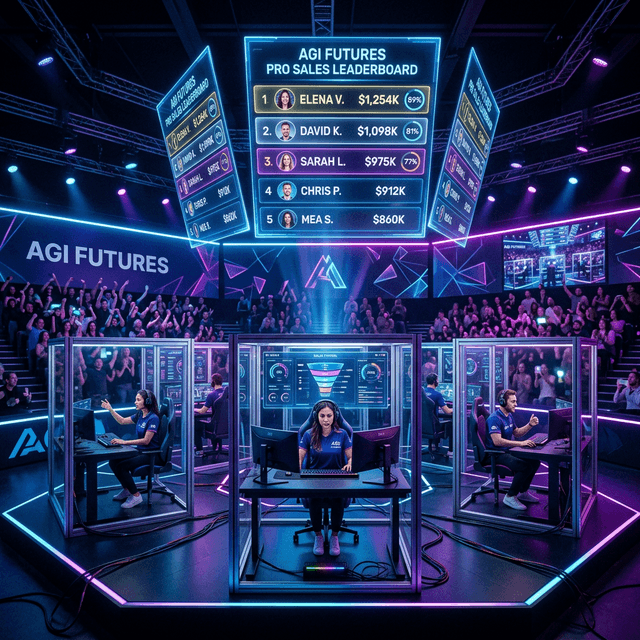
A career-switcher wants to break into software sales but has no experience. They play Pitch Quest, running through realistic cold calls and discovery simulations. The AI acts as a tough buyer, throwing curveballs and assessing their resilience. The user builds up their "Discovery Depth Index" and negotiation score. Once they hit Pro tier, they opt into Talent Discovery, making their validated stats visible to hiring managers.
Why now
- AI is already reshaping marketing and sales workflows. That raises the value of the specifically human layer, adaptability, judgment, and trust in ambiguous situations.
- The skill mix is moving fast. Employers expect major skill turnover this decade, which makes continuous simulation-based upskilling more strategic than one-time onboarding.
- The enabling tech is finally here. LLMs, voice models, better speech analytics, and optional spatial computing make realistic role-play cheap enough to deploy broadly. PwC’s work suggests immersive simulation can materially improve speed, confidence, and cost-effectiveness.
- Hiring is ready for better signal. The U.S. Office of Personnel Management says work samples mirror real job tasks, relate strongly to job performance, and are often perceived as fair. Recent review work also finds structured interviews among the strongest predictors, with lower racial-group impact than several alternatives.

Neglectedness
Market
The clean initial wedge is sales enablement and sales training.
Global Sales Enablement Platform Market
That is only the wedge. SellCraft also touches adjacent budgets in hiring, assessment, learning and development, and recruiting infrastructure.
Transferable Insight
"The deeper opportunity is not 'sales training software.' It is becoming the measurement and improvement layer for revenue-facing human skill in an AI-native economy."
Selling is one of the best training grounds for
AI-resilient human skill.
Because when someone sells well, they are really practicing:
Those are transferable to:
SellCraft is not just “sales training.”
It is really a simulation platform for
high-value human coordination skills,
with sales as the wedge because sales is measurable, urgent, and tied directly to revenue.
Business model
Consumer gives you distribution. Enterprise gives you revenue. The platform is strongest when both exist.
- Pitch Quest: Freemium, Pro, Pro+
- Proving Ground: Per-candidate pricing, hiring bundles, Talent Discovery monetization
- Practice: Annual seat license, setup fee, premium integrations, manager analytics
- Longer-term: Skill passport, benchmark data products, internal mobility and promotion workflows, vertical scenario packs
Moat
Consumer simulation data, hiring outcomes, and training outcomes improve each other. Most competitors only see one layer.
Practice becomes valuable when it is trained on real blockers, not generic scripts. That content gets richer with each customer.
Over time, SellCraft can map which behaviors predict ramp speed, win rate, promotion, and retention by segment and role.
Most training tools are bought, not loved. Pitch Quest can earn organic reach through clips, remixes, creator scenes, and campus leagues.
If SellCraft becomes the platform employers trust for fair, repeatable, job-related sales assessment, that credibility compounds.
AGI Futures edge
1. Product build gets cheaper, differentiation shifts to human trust.
2. Humans still decide under risk.
3. Meta-skills beat playbooks.
4. Human-AI duos dominate.
5. Talent liquidity rises.
6. Career anxiety creates demand for playful upskilling.
GTM
- Training-first: Run a 2-week Practice pilot tied to time-to-ramp and objection conversion. Expand seats. Attach Proving Ground for internal promotions and hiring.
- Hiring-first: Replace take-homes and shallow mock interviews with Proving Ground. Add Talent Discovery for hard-to-fill roles. Attach Practice post-offer.
- Consumer-first: Campus leagues, bootcamp partnerships, creator seasons, and highlight-clip virality. Upsell to Pro. Route top players to hiring partners.
Risks and failure modes
Scoring trust risk
High▼
If users think the rubric is fake, the product collapses.
Fairness risk
High▼
Screening products live or die on defensibility.
Consumer retention
Medium▼
“Fun once” is not enough. The game loop has to sustain identity, status, and improvement.
Cold start risk
Medium▼
Employers need high-signal scenarios before the dataset is rich.
Model commoditization
Very High▼
General models will make generic role-play easier. SellCraft wins only if the data, scoring, and employer trust stack get meaningfully better than commodity role-play.
Civilizational impact
This is not just a sales tool. It is part of a broader labor-market upgrade.
If AI compresses the cost of building, then the bottleneck shifts toward human coordination, persuasion, and trust. SellCraft helps more people build those skills earlier, signal them more fairly, and compound them faster. That improves matching, mobility, and productivity. It makes the labor market less credentialist and more performance-linked. That is directionally good for abundance.
Transferable Insight
"As AI makes it easier to build, analyze, and automate, the real advantage shifts to people who can earn trust, read the room, and get others aligned when the path is unclear."
Falsifiable experiment
Test the Simulation-to-Field Correlation
▼
Start with Practice, webcam-first, in one narrow vertical where objections are structured, expensive, and repeated (e.g. Cybersecurity, Medtech, or Capital Equipment).
Prove three things sequentially:
- Simulation scores correlate highly with live field behavior.
- Simulation practice materially reduces time-to-ramp or improves objection-to-next-step conversion rates.
- Managers actually trust the AI transcripts and rubrics enough to substitute standard shadowing.
Hypothesis Falsified If: Reps game the AI for high scores without field improvement, or if manager overhead to construct and verify the simulations outweighs the coaching time saved.
Acronyms & References▼
Acronyms
- SDRs: Sales Development Representatives
- AEs: Account Executives
- NPCs: Non-Player Characters
- SJT: Situational Judgment Test
- ATS: Applicant Tracking System
- L&D: Learning and Development
- RevOps: Revenue Operations
- CRM: Customer Relationship Management
- LMS: Learning Management System
- SQL: Sales Qualified Lead
- LLMs: Large Language Models
References
- Xueming Luo, Marco Shaojun Qin, Zheng Fang, and Zhe Qu, Artificial Intelligence Coaches for Sales Agents: Caveats and Solutions, Journal of Marketing (2021) →
- PwC, How virtual reality is redefining soft skills training (2022) →
- McKinsey, The state of AI in early 2024 (2024) →
- World Economic Forum, Future of Jobs Report 2025: The jobs of the future and the skills you need to get them (2025) →
- U.S. Office of Personnel Management, Work Samples and Simulations →
- Industrial and Organizational Psychology, Structured interviews: moving beyond mean validity… →
- Grand View Research, Sales Enablement Platform Market, 2025–2030 report summary →
Valuation Forecast
Probability that the category leader in this space reaches at least each valuation threshold.
AI Rationale
Building an AI-native sales mastery platform where humans practice against virtual customers faces skepticism from legacy leadership training incumbents. The AGI Futures forecaster model limits the probability of a $>100B outcome, anticipating rapid feature commoditization. However, the path to a high-margin $1B+ B2B training exit remains highly viable.
Implied Valuation Distribution (2030)
While the chart below displays cumulative probability, these boxes break down the exact probability of landing specifically within each valuation band.
Builder Proof-of-Work
Community submitted artifacts, notes, and implementations for this idea.