
Waypoint ─ AI Co-Pilot for Sustainable Development Deployment
Turns proven infrastructure solutions into deployable, financeable projects, with capital returns strengthened by verified real-world impact.
A planner uploads the facts of a place: households, water source, fuel use, road access, local materials, contractor capacity, budget, seasonality. Waypoint returns a ranked deployment plan, a field-ready build workflow, and a funding structure that matches real repayment capacity with proof-backed impact payments. Not another report that dies in a folder. A system that moves communities from need to funded to built to verified.
...still lack safely managed drinking water, and cook with polluting fuels. We are no longer mainly blocked by missing technical solutions.We are blocked by bad deployment systems.
Deployment is still fragmented,
bespoke, and slow.
The world already has a large library of workable solutions for rural water, clean cooking, sanitation, smallholder irrigation, storage, and other forms of distributed infrastructure. Engineering for Change’s Solutions Library exists precisely because many of these technologies are already known, documented, and comparable.
What does not exist at sufficient quality is the operating layer that turns those solutions into repeatable deployment. Planning is still bespoke. Capital is still fragmented across grants, concessional finance, climate finance, and local repayment channels. Field execution is still under-instrumented. Learning still evaporates between projects.
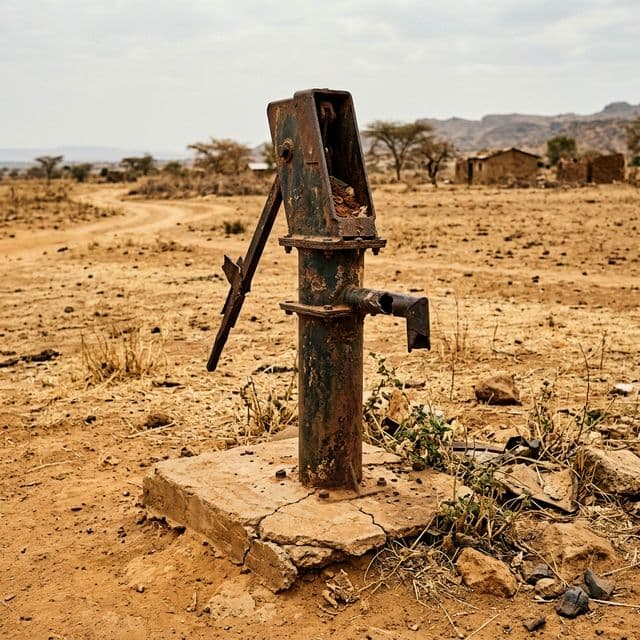
That creates a structural mismatch. High-value projects often have some real cash flow, but not enough to cleanly fit traditional infrastructure finance. They also create public-good value, but that value is usually measured badly or paid for late. So capital either walks away or settles for one-off grant logic. Meanwhile, the water sector alone in developing countries already spends about $164.6 billion annually, yet still faces an annual funding gap of $131.4 billion to $140.8 billion, with budget execution only around 72%.
The civilizational cost is severe. Unsafe water, weak sanitation, and dirty cooking lock communities into disease burden, time poverty, fuel insecurity, and preventable emissions. Household air pollution remains a major global health burden, and water access remains far from solved.
From proven design to proven deployment.
Waypoint operates at the intersection of local context, standardized underwriting, and field-level execution.
1. Upload Context
Planners upload conditions: water, budget, logistics.
2. Waypoint Engine
AI generates ranked bundles and proof-backed funding packets.
3. Flow of Capital
Outcome-linked pools sync with verified execution plans.
4. Guided Build
Field teams execute via mobile co-pilot and capture data.
5. Verified Outcome
Live dashboard updates funders, unlocking scaling.
Waypoint is the deployment and financing layer for sustainable infrastructure.
AI Planning Layer
It starts with planning. The system ingests local conditions and generates ranked project bundles, bills of materials, deployment sequences, operating assumptions, maintenance requirements, and risk flags. It does not merely say what could work. It outputs what should be built first, with what inputs, under what constraints.
Financing Layer
On top of that sits Waypoint’s core funding structure: the Waypoint Deployment Pool. This is one flexible capital model, not five different business lines. Projects are financed from a shared pool whose returns come from a blend of two sources. The first is direct project cash flow. The second is verified impact payments.
Field Co-Pilot Layer
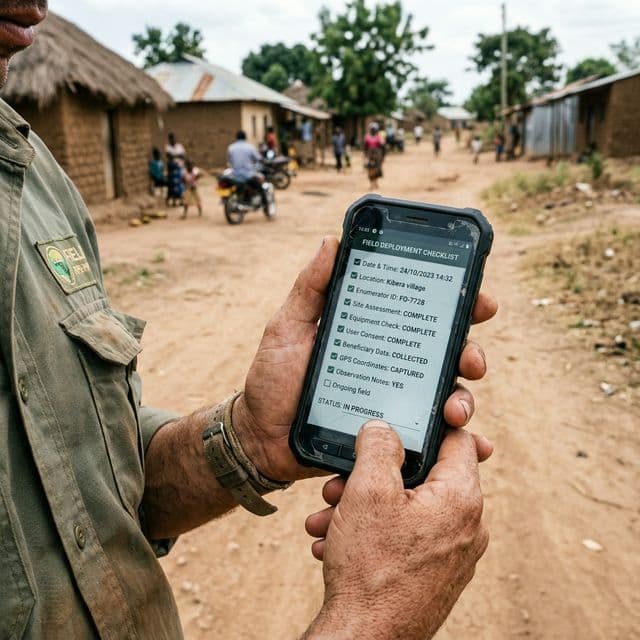
It then moves into field execution. Contractors, technicians, and local operators get guided workflows for procurement, installation, commissioning, maintenance, and evidence capture. Every deployment records what was planned, what was procured, what was actually built, what changed on site, and what outcomes verified.
Same structure, different repayment mix.
That is what makes Waypoint distinctive. It does not force every project into the false choice between pure grant dependence and fully commercial finance. It prices and funds projects based on both narrow cash flows and verified public-good value.
Tagline: From proven design to proven deployment.
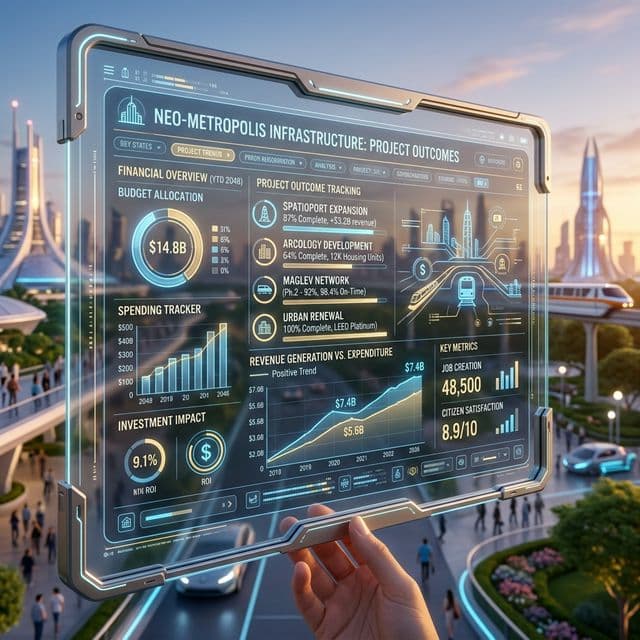
ICP Examples
Select a target profile to see how Waypoint orchestrates infrastructure deployments.
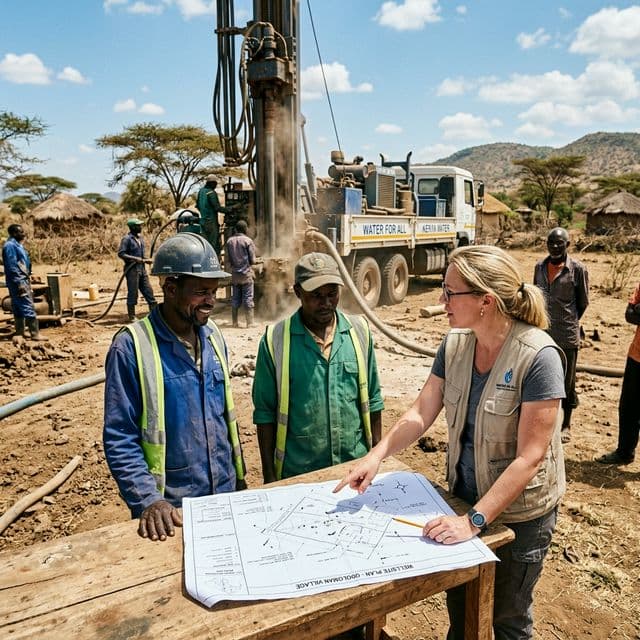
A: 12-village water cohort.Waypoint identifies where borehole rehabilitation is the highest-return intervention versus rainwater capture. Projects are financed by mixed structures in the same pool.
B: Clean cooking deployment.Waypoint finances the full portfolio with different repayment mixes inside the same pool depending on ability to pay.
C: Mixed water plus cooking.Waypoint sequences water storage first, then clean cooking, recognizing compounding household time burdens.
Neglectedness
Massive spending base,
missing orchestration.

Market Scope
The spending base is already large. Water alone has annual developing-country spending in the hundreds of billions, yet a very large funding gap remains. [4]
From first principles, this market gets bigger as intelligence gets cheaper. Once planning, underwriting support, and field guidance become dramatically less expensive, more categories of small-scale infrastructure become financeable. The winning company makes known solutions legible to capital and reliable in the field.
Why Now
First, the information substrate exists. Open-access technical repositories are good enough to support serious structured planning. [3]
Second, the field interface exists. Globally, 78% of people aged 10 and over owned a mobile phone in 2023, giving distributed infrastructure deployment a viable digital workflow layer even in resource-constrained environments. [7]
Third, the payment and capital rails are maturing. Mobile money handled more than $2 trillion in transaction value in 2025, and the World Bank’s $200 million Clean Cooking Outcome Bond in Ghana showed that outcome-linked capital is now a live instrument. [6][8]
Waypoint is a timing bet on those three curves intersecting.
Two revenue streams, reinforcing each other.
PlatformCoordination Infrastructure
Verified Outputs
Software Revenue
NGOs, governments, developers, and infrastructure operators pay for the platform that turns local conditions into deployment plans, contractor workflows, evidence capture, and verified outcome reporting.
Transaction Revenue
The second is a platform and servicing fee on capital deployed through the Waypoint Deployment Pool. This is the heart of the company. Investors fund a pool of projects whose returns come from a blended repayment stack.
MRV & Benchmarking
Some repayments come from direct project cash flows, the rest from verified impact. The business scales because better software improves deployment quality, better deployment data improves underwriting, and better underwriting attracts more capital into the pool.
Moat Potential
Score91/100Waypoint’s moat is not "we use AI." That becomes cheap. The moat is the deployment dataset and the capital-feedback loop built on top of it.
Moat Potential
Waypoint’s moat is not "we use AI." That becomes cheap. The moat is the deployment dataset and the capital-feedback loop built on top of it.
Difficulty to Bring to Market
Score78/100This is buildable now, but operationally hard. The difficulty is earning trust from capital providers and field operators at the same time.
Difficulty to Bring to Market
This is buildable now, but operationally hard. The difficulty is earning trust from capital providers and field operators at the same time.
Unique Go-To Market
Start where the pain is repeated, measurable, and expensive.
The best first buyers are mid-sized NGOs and district-scale deployers in East Africa running recurring water and clean cooking projects. They already have project flow. They already feel the planning pain. They already need better capital coordination.
The public growth engine is visible proof. Every completed Waypoint cohort becomes a live case study: timeline, repayment mix, contractor performance, verified outcomes, maintenance record. Waypoint should become known for one thing early: if a project runs through Waypoint, it is far more legible to both builders and funders.
Transferable Insight
Waypoint sits at the point where intelligence touches infrastructure, capital, and verified outcomes. That makes it well positioned for an AGI future where the limiting factor is no longer reasoning, but trustworthy execution in the physical world.
Civilizational Impact.
This is a civilization-building company.
If AGI makes intelligence abundant while the physical world stays bottlenecked by coordination, trust, and execution, then systems like Waypoint determine whether abundance actually reaches the ground. Water, sanitation, energy access, and clean cooking are foundational inputs into health, dignity, productivity, resilience, and social stability. [1][2]
87Impact Score
KPIs
- 1 Planning time per project, from intake to deployment-ready plan.
- 2 Funding conversion rate, from approved plan to committed capital.
- 3 On-time, on-spec completion rate for projects executed through Waypoint.
- 4 Verified outcome attainment rate at 6 and 12 months.
- 5 Repeat deployment rate from the same operator, funder, or geography.
Open Source Priority
Acronyms & References
Valuation Forecast
Probability that the category leader in this space reaches at least each valuation threshold.
AI Rationale
A standard venture probability curve has been applied to this category, anticipating typical software-as-a-service market dynamics and capital requirements.
Implied Valuation Distribution (2030)
While the chart below displays cumulative probability, these boxes break down the exact probability of landing specifically within each valuation band.
Builder Proof-of-Work
Community submitted artifacts, notes, and implementations for this idea.